
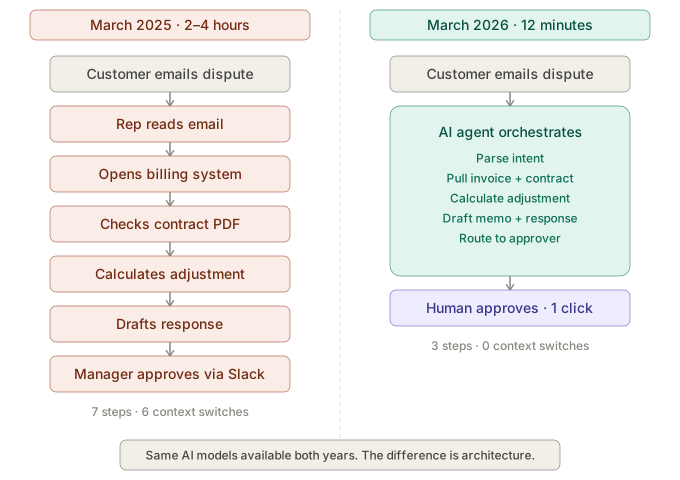
Left, a finance controller kicks off month-end close the way she always has — pulling reports from three systems, reconciling manually, chasing approvals over email. Five days.
Right, her counterpart triggers an agentic workflow that pulls the same reports, flags mismatches, drafts reconciliation entries, and routes exceptions by materiality threshold. A day and a half. Same ERP. Same headcount. One redesigned the work. The other plugged in a copilot.
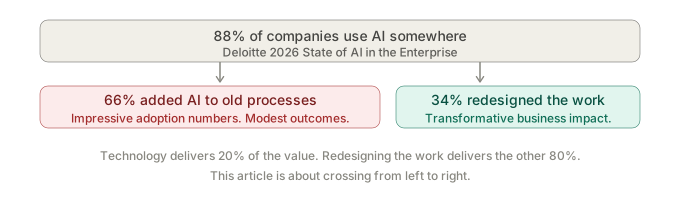
Deloitte’s 2026 State of AI report:
From tool to workflow
In 2025, AI was a brain in a jar. In 2026, the jar broke open. By year’s end, 40% of enterprise apps will embed AI agents — up from under 5%.
Two industries, one mistake, one fix
Klarna went all-in on AI customer service in 2024. Then overcorrected. Then found the hybrid that worked.
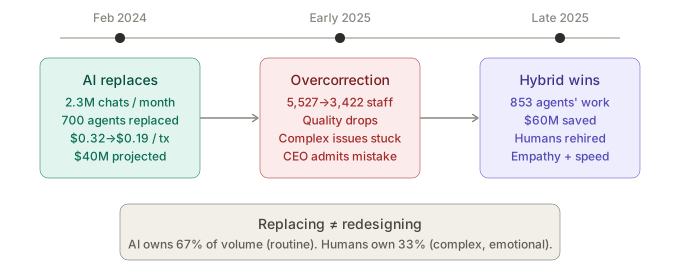
Sources: 2.3M chats, 11→2 min resolution · 5,527→3,422 headcount, IPO filing · $0.32→$0.19/tx, Q1 2025 earnings · CEO: cost “too prominent” · 853 agents’ work, $60M saved, Q3 2025
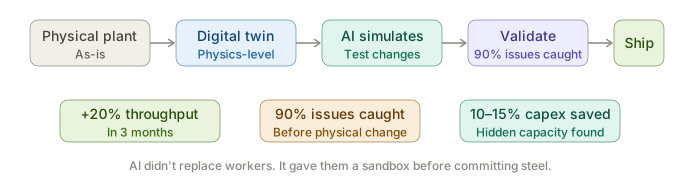
Now watch it on the factory floor. PepsiCo and Siemens digitally twinned U.S. manufacturing facilities so AI agents could simulate changes before any physical modification.
Three things the reports buried
Worse baselines produce bigger AI numbers. Klarna’s CEO admitted the company “was not necessarily the best in the world when it came to IVRs and FAQs” before deploying AI. That gap is exactly why the lift looked staggering — and why better-run companies can’t replicate those gains. Audit your process maturity before setting AI targets.
Your employees already crossed the AI divide. Your org hasn’t. A 2025 MIT study found employees at over 90% of companies use personal AI tools for work. Only 40% of companies bought an official subscription. Learn from their choices before buying another enterprise license.
Revenue from AI is still mostly a wish. 74% hope to grow revenue through AI. Only 20% are. First movers who crack AI-driven revenue — not just cost savings — have the market largely to themselves.
Your 90-day path
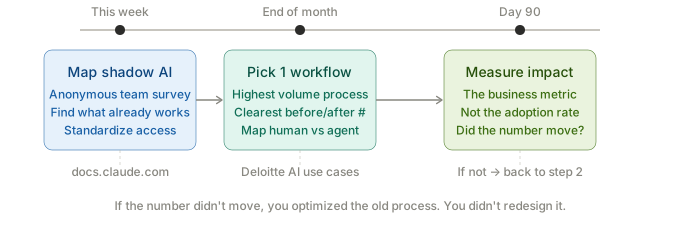
- Map shadow AI: Claude docs · OpenAI enterprise docs
- Pick one workflow: Deloitte’s 80+ AI use cases by industry
- Measure what moved: Resolution time, throughput, cost per transaction — the number that hits the P&L
Note: If your AI touches hiring, credit, or customer scoring in the EU, the AI Act high-risk obligations hit August 2, 2026. Start with the Orrick 6-step checklist — in parallel, not instead.
Two companies. Same desk. Same budget. Same models.
One added AI to the way things already worked. The other picked one workflow, tore it apart, and rebuilt it around what agents can do. Twelve months from now, one of them won’t understand how the other got so far ahead.
The tools don’t pick sides. But the architecture does.